English| EUR
Suggested for you
More currencies
Choose a language
Camel riding in Morocco is concentrated in a handful of places, from the Erg Chebbi sand sea at Merzouga to the grey flats of Agafay and a few Atlantic beaches. This where to ride camels in Morocco guide maps each option against the terrain, the light and the time it costs. Access details for the dunes themselves follow below.
Quick answer
The main place to ride camels in Morocco is the Erg Chebbi Dunes at Merzouga, where the dunes are open 00:00–23:59 every day and entry costs 0 EUR; fees apply only to booked commercial camel excursions. Aim to arrive between 05:00 and 17:30, which avoids peak midday heat. Agafay and Essaouira are closer alternatives, but smaller.
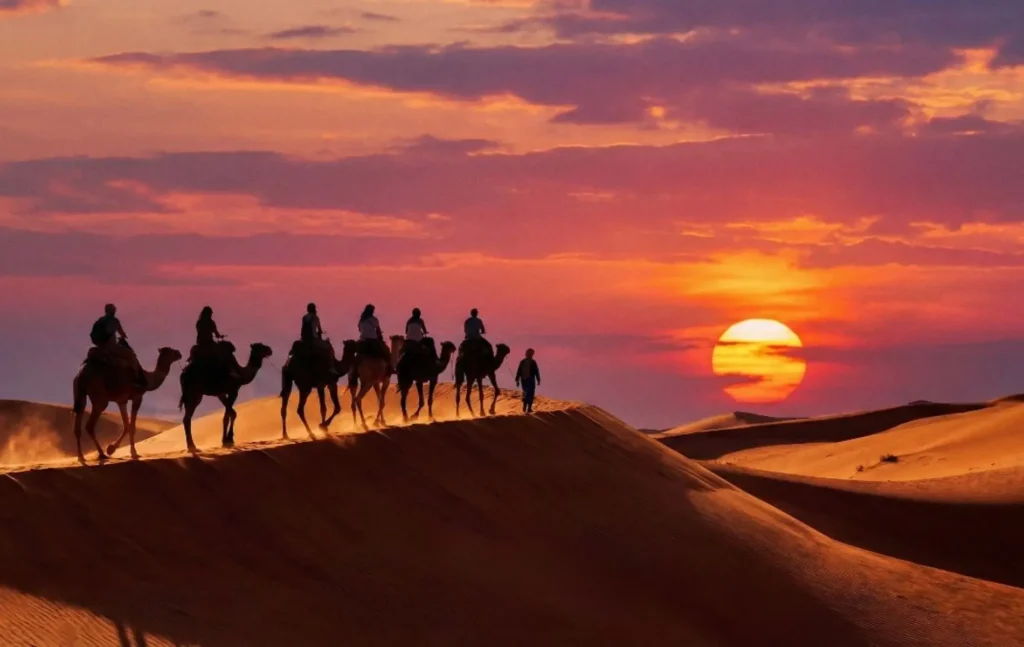
Morocco's riding camels are almost always dromedaries, the single-humped animals bred for Saharan heat rather than the two-humped Bactrians of Central Asia. That biological footnote shapes the map. Anyone asking where to ride camels in Morocco is really asking where the country turns to sand, because the national terrain is mostly stone desert, or hamada, and only a few true sand seas interrupt it. The largest and most photographed is Erg Chebbi, the ridge of orange dunes that rises behind Merzouga in the Tafilalet, close to the Algerian frontier. Crests there reach roughly 150 metres, and the erg runs some 22 kilometres north to south. A second sand sea, Erg Chigaga, lies beyond M'Hamid at the end of the Draa valley, wilder and harder to reach. Between them sit the lower dunes near Zagora, long used as a short-trip substitute for travellers short on days. Not every ride happens on dunes. Agafay, forty minutes from Marrakech, is a lunar expanse of grey hamada that photographs like desert and functions as a half-day stand-in; its camels walk gravel, not sand. On the Atlantic coast, a balade à dos de dromadaire usually means a beach line, often south of Essaouira towards Diabat and the Oued Ksob estuary, where the animals are led at a walk along the tideline. Agadir, Taghazout and Oualidia run similar coastal strings. The experience differs in kind rather than degree: a Merzouga camel trek crosses silence and shifting ridges, while a coastal ride is a brisk hour beside surf and argan scrub. Operators across all these places share a working pattern: a cameleer on foot, a string of three to a dozen dromedaries, blanket-padded wooden saddles, and a turn at a dune crest or a nomad bivouac before the return. Understanding that pattern matters more than comparing brochures, because it is what separates a token photo stop from a genuine desert crossing. Choosing between them is a question of time and intent rather than quality. Erg Chebbi Dunes, Merzouga, Morocco sits far east of the main tourist triangle, so the deep Sahara usually asks for at least two nights and a long overland run through the Dades or Todra gorges. Agafay and the coastal strings fit inside an afternoon. Light is the other variable: dromedary shadows on a dune face read very differently at first light than under a flat midday sky, and most photographers plan the whole trip around that single fact. Animal welfare deserves the same weight. Reputable operators rotate their herds, keep saddles padded, cap riding time, and will say so plainly when asked; a thin, sore-backed animal standing in full sun is a reason to walk away. Riders should also expect a swaying, high-seated gait that unsettles stiff backs, and sand that finds every camera seal. For anyone still weighing where to ride camels in Morocco, the practical route is to fix the number of nights available first, then match the destination to it, and let the booking pages confirm what each desert excursion actually includes.
“The question is less which desert than how many nights a traveller can give it.”
The dunes of Erg Chebbi are accessible to visitors throughout the week. Camel excursion departures operate based on the schedule of booked commercial providers.
Access to the Erg Chebbi dunes is free for all visitors. Costs for camel riding are associated exclusively with commercial excursion providers.
Verdict: Public access to the dunes costs 0 EUR, while commercial camel excursions require payment based on the specific service provider chosen.
The Erg Chebbi Dunes are located near the village of Merzouga in southeastern Morocco. Reaching this destination typically requires traveling via the N13 road, which serves as the primary artery connecting the region to larger cities.
Follow the N13 highway toward Merzouga
Supratours or CTM bus lines to Merzouga
Grand Taxi from Rissani or Erfoud
The most efficient approach is to arrive at your designated camel trekking meeting point in Merzouga within the best arrival window of 05:00–17:30 to ensure safe transit and optimal lighting.
Preparation ensures a comfortable experience when exploring the Erg Chebbi desert landscape.
Carry at least two liters of water per person, as desert air accelerates dehydration even when you do not feel thirsty. Relying on stops is insufficient, so keep your supply in an accessible daypack.
Wear long, loose-fitting trousers to prevent skin irritation caused by the saddle and coarse camel hair. Lightweight, breathable natural fibers like cotton or linen provide the best protection against direct sun.
Apply high-SPF sunscreen to your face, neck, and hands before departure, and wear a wide-brimmed hat that stays secure in windy conditions. Sunglasses with polarized lenses are recommended to reduce glare from the bright sand dunes.
Lean slightly backward when the camel stands up or sits down to maintain your balance. Hold the saddle handle firmly during these transitions, as the animal moves in a rhythmic, swaying motion that can be unexpected for first-time riders.
Bring a scarf or buff to cover your nose and mouth if wind speeds increase and sand begins to shift. This also serves as extra protection against the sun during the hottest parts of your excursion.
Everything you need to know about where to ride camels in morocco
The Erg Chebbi dunes in Merzouga are the primary location where to ride camels in morocco for an authentic desert experience. These golden sand landscapes provide the most iconic setting for guided treks. Many visitors also consider Zagora or M'Hamid as alternative spots for camel trekking in Morocco. Researching these desert gateways will help you decide where to ride camels in morocco based on your travel itinerary.
Camel Ride Prices in Morocco
Read more GuideWhat to Wear on a Camel Ride in Morocco
Read more GuideEthical Camel Riding in Morocco
Read more Tickets & toursCamel Rides in Fes
Read more Tickets & toursCamel Rides in Marrakech
Read more Tickets & toursSahara Desert Camel Treks
Read more Tickets & toursCamel Rides in Agadir
Read more GuideCamel Riding in Morocco: Planning Guide
Read more